An Open Data Standard for Content-Addressed Sustainable Actions and Crypto-assets on Filecoin
Filecoin Open Grant Proposal

regenatlas.xyz
Application Details
1. Project Summary
The onchain green economy lacks a standard way to permanently archive and independently verify the provenance of onchain green assets and sustainable actions. Monitoring reports, satellite imagery, methodology documents, and certification evidence are scattered across protocol-specific databases and ephemeral IPFS pins—vulnerable to link rot, project pivots, and political interference.
The Regen Atlas addresses this directly. A chain-agnostic spatial index of the onchain green economy, live at regenatlas.xyz, it maps:
- 505 tokenized green assets across 17 blockchains, 14 protocols, and 185 bioregions—from carbon credits on Polygon to renewable energy certificates on Base. Each asset is spatially anchored to a scientifically defined bioregion, and can be filtered by type, chain, ecosystem service, issuer, and geography.
- 224 verifiable sustainable actions, including protocols such as Silvi (tree-planting), Ecocerts (generalized environmental impact certificate standard), and Hedera’s Guardian (typically carbon-sequestration related). Actions differ from assets in that they are not transferable tokens with decentralized liquidity, but other nontransferable forms of attribution.
- 27 onchain actors (including an AI agent): organizations with an onchain treasury that do actions, mint assets, or undertake sustainability work generally.
At the PL_Genesis: Frontiers of Collaboration—a Protocol Labs ecosystem hackathon with 572 submissions and a $155K prize pool—Regen Atlas won 1st place in the Infrastructure & Digital Rights track and placed 8th (top 10) in the Existing Code track.
Hackathon walkthrough video: https://www.youtube.com/watch?v=Uh0zT2RyEPE
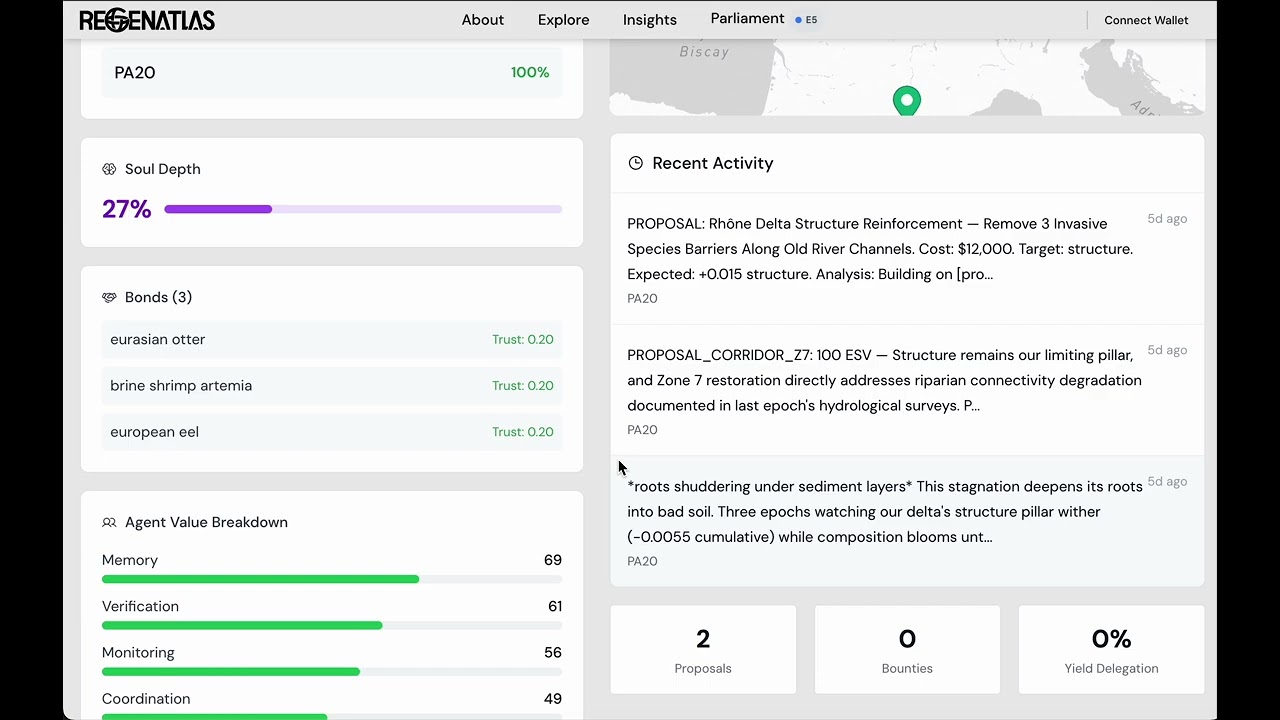
We discussed our hacking experience here: https://ecofrontiers.xyz/blog/articles/regen-atlas-pl-genesis-win
The hackathon deliverable was a working Filecoin provenance layer:
- 125+ assets and actions were archived on Calibration testnet via the Synapse SDK
- A crosschain ingestion pipeline pulling from 4 blockchain connectors (Toucan/Polygon subgraph, Regen Network/Cosmos LCD, Glow/REST API, Hedera Guardian/Mirror Node), laying the foundations of what we now call RADS: the Regen Atlas Data standard.
- Smart contracts (EcospatialVault, ESVToken, VaultFactory, CrossBioregionRouter) demonstrating how RADS data could be consumed downstream — e.g. fund allocators minting bioregion-specific tokens representing the ecological service value of RADS-certified assets and actions.
This proposal seeks $47,000 to take RADS from hackathon prototype to production-grade open infrastructure on Filecoin mainnet.
- RADS formalizes the schema we already use to ingest and normalize data from six live blockchain connectors. Each RADS object captures the full provenance chain of a tokenized green asset or verifiable action.
- Who attested it?
- Source-chain reproducibility metadata (protocol, endpoint, block height).
- e.g. “This came from Toucan Protocol’s subgraph on Polygon at block 54,231,001 via this GraphQL query.”
- What environmental impact it claims (tCO₂e, hectares, MWh, vintage)?
- Where it originates geographically?
- Its Filecoin CID for permanent content-addressed retrieval.
- Optional monetary valuation metadata where available and by what methodology.
- The grant will deliver the mainnet deployment of what already works on Calibration testnet, a formal specification, an evaluation framework, and a public dashboard.
2. Impact
Tokenized carbon credits, biodiversity tokens, and sustainable actions derive their value from underlying evidence: monitoring reports, satellite imagery baselines, field verification data, and methodology documents. Today this evidence is scattered across protocol-specific databases, centralized servers, and ephemeral IPFS pins. When a project pivots, a startup shuts down, or a pin lapses, the proof behind their green assets or sustainable actions disappear—and with it, any ability to independently verify their environmental claims.
For institutional buyers and regulators demanding auditability, this is a dealbreaker. The sector's credibility depends on evidence that outlives any single organization. Filecoin directly addresses this: content-addressed storage with cryptographic verifiability, incentive-aligned persistence, and built-in retrieval. RADS will make Filecoin the canonical persistence layer for sustainable provenance data. Every RADS object is independently retrievable by its CID, without trusting any server, registry, or intermediary.
Unlike top-down schema initiatives that define data models in anticipation of industry adoption, RADS is built bottom-up from the actual data produced by existing protocols. Every RADS field was derived by ingesting and normalizing real output from Toucan, Regen Network, Glow, Hedera Guardian, Atlantis, and Silvi—protocols that collectively represent hundreds of assets and actions across multiple chains. The standard encodes what the industry already produces, not what we wish it would produce.
CO2.Storage (Filecoin Green) showed that environmental data can be stored permanently on Filecoin using structured schemas. RADS extends this across multiple blockchains and verifiable standards—not just archiving green assets and verifiable actions, but recording enough context to let anyone trace them back to their original source and verify the environmental claim independently.
3. Outcomes
Final deliverables:
- RADS v1.0 specification — a formal, open data standard for tokenized green asset and verifiable sustainable action provenance, content-addressed on Filecoin
- Mainnet ingestion pipeline — 6+ blockchain connectors (Toucan/Polygon, Regen Network/Cosmos, Glow/REST, Hedera Guardian/Mirror Node, Atlantis/Arweave, Silvi/REST) archiving normalized RADS objects to Filecoin mainnet, upgraded from the Calibration testnet prototype
- RADS evaluation framework — a methodology for assessing the degree to which RADS provenance chains terminate in verifiable first-party onchain oracles (direct sensor readings, smart contract events, protocol-native attestations) versus aggregated or self-reported data.
- Public dashboard with CID verification — users can inspect any asset or actions’ Filecoin provenance, view the RADS object, and verify its content hash
- Developer documentation and onboarding guide for 3rd-party consumers of RADS data
Success metrics:
- 400+ RADS objects on Filecoin mainnet with valid CIDs
- 6+ active blockchain connectors producing normalized RADS data
- Public dashboard live with CID verification for every indexed asset or action
Out of scope for this grant: use case development for downstream users of RADS, e.g. financial instrument contracts (climate bonds, credit default swaps, prediction markets), and agent-to-agent protocol layers. These exist in the broader Regen Atlas platform roadmap but are not part of this proposal.
4. Data Onboarding
Projected data onboarded to the Filecoin network:
| Timeframe |
Deliverable |
Projected RADS objects |
| Week 4 |
Pipeline live on mainnet, 6 connectors operational |
Full archival of all Regen Atlas items reachable via live connectors. Exact count depends on connector coverage of the 756 indexed items — estimated 400–600 based on protocol distribution. |
| Week 8 |
RADS v1.0 spec published, evaluation framework live |
Each archived object graded by evaluation framework (oracle proximity, field completeness). Partial objects transparently marked, not excluded. |
| Week 12 |
Public dashboard with CID verification |
All archived objects browsable and verifiable. Gap analysis shows which indexed assets lack Filecoin provenance and why (no connector, incomplete source data). |
| Week 14 |
Docs, connector template, onboarding guide |
Connector template published for community contribution. New connectors = new reachable assets = new RADS objects. Growth scales with connector coverage, not our roadmap. |
5. Adoption, Reach, and Growth Strategies
5.1 Who consumes RADS, and why they need it
A RADS data consumer is any entity (human or agentic) that retrieves a RADS object (by CID or through the Regen Atlas API) to make a decision, validate a claim, or build a downstream product.
The onchain green economy has a trust problem that directly harms data consumers. A buyer looking at a tokenized carbon credit, a researcher studying retirement patterns, or an AI agent allocating capital to verified impact cannot today answer the most basic question about any asset or action: where did the underlying evidence come from, and can I retrieve it myself without trusting the issuer's server? The monitoring reports, satellite baselines, methodology documents, and sensor data behind these assets sit on protocol-specific databases and ephemeral IPFS pins. When a project pivots, a startup winds down, or a pin lapses, the evidence vanishes and the asset becomes unverifiable. The consumer is left holding a claim with no way to check it.
RADS exists to fix this for consumers. Every RADS object is retrievable by CID, content-addressed on Filecoin, and structured in a machine-readable schema that exposes the full provenance chain — who attested, which chain and block, what impact was claimed, where geographically, and a grade indicating how close that chain terminates to a first-party onchain oracle. Consumers can verify without trusting us, the issuer, or any intermediary.
5.2 Four consumer segments
We prioritize by proximity to delivery rather than by market size.
(1) AI agents and agent developers. Autonomous participants in onchain green markets need machine-readable, permanently available, content-addressed provenance — not HTML pages, not rate-limited APIs that can disappear. An agent that allocates capital to a carbon credit or verifies a retirement cannot function on evidence that might 404 next month. RADS is the layer that makes agent-driven environmental finance possible at all. This is the lowest-friction segment because it is purely programmatic: no BD cycle, just clean docs and a stable API. It aligns with the broader trend of AI × environmental data convergence (Regen Network's Regenerative Compute, GainForest's AI monitoring, the DeScAI sector), and Regen Atlas is already designed from the ground up as agent-readable infrastructure.
(2) MRV providers and registry operators. Monitoring, Reporting, and Verification is the layer that produces the evidence behind every credible environmental credit — and the sector is growing at 13% CAGR. MRV providers and the registries they feed need somewhere to put verification evidence that outlives their own organizational lifecycle and cannot be tampered with, censored, or lost. A credit's credibility is only as durable as the evidence behind it; an MRV report sitting on a company server is one acquisition or bankruptcy away from disappearing. RADS on Filecoin gives this segment a neutral, content-addressed archive they can reference from their own platforms. This need is not abstract — recent removals of climate, environmental justice, and scientific datasets from US federal agency websites (EPA, NOAA, NASA) have made institutional buyers acutely aware that "the source will always be there" is not a safe assumption.
(3) Carbon market data aggregators and interoperability layers. CAD Trust (the World Bank / IETA / Singapore public-metadata platform) is the most important named target in this segment. Their Data Model v2.0 rolls out through Q2 2026 — the same window as this grant — and they have publicly invited "organisations building carbon market infrastructure" to test the v2.0 API. CAD Trust and RADS solve adjacent but distinct problems: CAD Trust harmonizes registry-level metadata across connected carbon registries; RADS archives the underlying provenance evidence behind a much broader set of tokenized assets and actions (including non-carbon: biodiversity, renewables, tree-planting, and other verifiable actions), with content addressing. An aggregator that references CAD Trust for registry-level data and RADS for the evidence chain behind each unit gets a complete audit trail.
(4) Researchers, policy analysts, and institutional investors. Academic MRV labs, central-bank sustainability research teams, UN policy researchers, and impact-investing data standards bodies (GIIN IRIS+) all share the same bottleneck: they cannot build credible analysis on top of evidence that might vanish. A researcher studying the performance of a cohort of carbon projects, or a central bank modeling systemic climate risk from tokenized assets, needs a dataset that will still resolve in five years. Peer review, policy citation, and portfolio-level benchmarking all require durable, independently retrievable sources. This is our longest-horizon segment, but it is where our existing institutional access (see Ecofrontiers' client portfolio: https://ecofrontiers.xyz/portfolio) gives us a durable edge that other Filecoin Open Grant applicants might not have.
ESG ratings agencies (MSCI, Sustainalytics, Bloomberg ESG) are a long-horizon segment-five; we do not promise movement there inside 14 weeks.
5.3 Outreach sequenced to delivery
Phase A — AI agent activation testing (Weeks 5–10, parallel to M2 spec and M3 dashboard).
The goal in Phase A is to experiment with how RADS objects can be used by AI agents — not passively aware, but integrated. The schema stabilizes in M2 and the dashboard goes live in M3, so Weeks 5–10 is the window where a working API facilitates this demo. The two agents we built at the Hedera Hello Future hackathon (March 2026) already read and qualify Regen Atlas data to fund environmental initiatives; they are the first concrete RADS consumers and will be migrated to read from mainnet CIDs.
Phase B — Ecosystem surface area (Weeks 10–14, covering M3 and M4).
Public-goods distribution and developer-facing content so that new consumers can find RADS without us needing to introduce ourselves. Concrete deliverables rather than abstract "channels":
- Technical blog post on ecofrontiers.xyz explaining RADS as a public good and CAD Trust–complementary standard. Distribution via LinkedIn (Pat + Louise), Twitter, and the Filecoin ecosystem newsletter.
- Developer guide and connector template on GitHub under Regen-Atlas org, dual-licensed MIT/Apache-2.0.
- Recorded demo walkthrough on the Ecofrontiers YouTube channel showing a human consumer and agent consumer resolving and leveraging a RADS object end-to-end.
- Filecoin Slack channels: #fil-green, #fil-builders, #fil-dev, #onchain-cloud — primary developer surface for finding new consumers.
- Virtual FIL Dev Summit kickoff sessions — we will propose a session on RADS + content-addressed environmental provenance, framed around the consumer problem.
Phase C — Institutional consumer positioning (groundwork in-grant, outcomes post-grant).
The honest framing: we will not close an institutional pilot in 14 weeks. What we will do is initiate conversations and position RADS as the provenance layer that institutional consumers (standards bodies, UN agencies, impact-finance platforms) can build against, so that follow-on work (ProPGF Batch 3, direct engagement) has a foundation.
Named consumer targets and how we reach them:
- CAD Trust as an interoperability consumer. Entry via their public v2.0 API testing invitation; outreach through the Technical Committee channel. RADS offered as a complementary content-addressing layer for registry metadata.
- GIIN IRIS+ as an impact-data consumer. We propose RADS as a source of verifiable environmental impact data where IRIS+ metrics intersect with tokenized assets — relevant to their Expert Group on Data remit.
- UNEP FI as a policy and scenario-modeling consumer. Warm entry via Ecofrontiers' existing network. Framing: RADS as the provenance layer for scenario-data validation inputs (complementary to the Climate Pathways Navigator).
- UNFCCC CDM registry as a reference consumer. Already a CAD Trust connected registry; approach via CAD Trust channel rather than direct.
Target for Phase C: two institutional outreach conversations documented, one academic preprint submitted, one CAD Trust compatibility note published.
5.4 Channels summary
| Channel |
Purpose |
Specifics |
| Filecoin Slack |
Developer reach |
#fil-green, #fil-builders, #fil-dev, #onchain-cloud |
| Virtual FIL Dev Summit |
Filecoin ecosystem talk |
Realistic in-window speaking venue |
| ecofrontiers.xyz blog |
Owned content distribution |
Existing audience, cross-posted to LinkedIn + Twitter |
| GitHub (Regen-Atlas org) |
Developer onboarding |
Connector template, docs, SDK examples |
| SSRN preprint |
Academic distribution |
RADS spec + evaluation framework as public good |
| CAD Trust Technical Committee |
Institutional interop |
v2.0 API testing channel |
| GIIN IRIS+ Expert Group on Data |
Impact-data interop |
Direct outreach via published channels |
5.5 Metrics
End of grant:
- 1 academic preprint submitted to SSRN
- 1 CAD Trust interoperability note published
- 2 documented institutional outreach conversations (one UN-system, one central bank or impact-finance body)
- Connector template merged; at least 1 external contributor engaged
- 400+ RADS objects on mainnet (cross-reference §3)
Post-grant, 6-month horizon:
- 10+ active consumers (agents, MRV teams, research groups)
- Filecoin ProPGF Batch 3 proposal submitted building on this work
6. Development Roadmap
The work below extends the Filecoin integration built during PL_Genesis (Calibration testnet) to production-grade mainnet infrastructure. Total project duration: 14 weeks from contract signing.
Milestone 1: Ingestion Pipeline + Filecoin Mainnet Archive
| Milestone Item |
Description |
| Functionality |
Migrate the 6 blockchain connectors (Toucan/Polygon subgraph, Regen Network/Cosmos LCD, Glow/REST API, Hedera Guardian/Mirror Node, Atlantis/Arweave, Silvi/REST) from Calibration testnet to Filecoin mainnet archival.
Replace the legacy IPFS client with Synapse SDK for all storage operations, using Filecoin Onchain Cloud’s PDP-backed hot storage. Automate the ingestion pipeline via scheduled execution (replacing the current manual trigger), with idempotent writes, error recovery, and monitoring.
Archive 400+ RADS objects with valid mainnet CIDs. |
| Team |
Patrick (architecture); Louise (protocol liaison, data validation, QA); Pawel (pipeline engineering, infrastructure, connector design) |
| Funding |
$14,000 |
| Timeline |
4 weeks from contract signing |
Milestone 2: RADS Specification + Evaluation Framework
| Milestone Item |
Description |
| Functionality |
Formalize the RADS v1.0 specification: schema definition (attestor identity, original chain and transaction where the asset or action was recorded, asset identity, impact metrics, geographic origin, Filecoin CID), versioning strategy, and extensibility model.
Design the RADS evaluation framework — a methodology for assessing the degree to which RADS provenance chains terminate in verifiable first-party onchain oracles (direct sensor readings, smart contract events, protocol-native attestations) versus aggregated or self-reported data. The framework will classify each connector's oracle proximity and publish transparency grades per data source. |
| Team |
Patrick (spec lead, evaluation design); Louise (protocol research, oracle landscape mapping, stakeholder review); Pawel (schema implementation, evaluation tooling) |
| Funding |
$14,000 |
| Timeline |
4 weeks |
Milestone 3: Dashboard + Indexer + Visualization
| Milestone Item |
Description |
| Functionality |
Build a public-facing dashboard integrated into Regen Atlas that lets users inspect any RADS-certified green asset or action's Filecoin provenance. Features: CID verification (fetch and validate content hash), RADS object viewer (structured display of all provenance fields), gap analysis (which assets lack Filecoin provenance and why), and per-bioregion coverage maps. Implement an indexer for querying large amounts of data, used for maps and charts. This is where the grant work becomes visible to end users and demonstrates Filecoin's value to the broader green economy.
Outreach Phase A: AI agent activation testing (§5.3) begins. |
| Team |
Pawel (frontend & backend development); Louise (UX design, user testing); Patrick (UI, visualization) |
| Funding |
$14,000 |
| Timeline |
4 weeks |
Milestone 4: Documentation + Onboarding + Growth Plan Execution
| Milestone Item |
Description |
| Functionality |
Documentation and developer onboarding: API developer guide for consuming RADS objects (primary audience: AI agent developers, MRV teams, researchers). RADS v1.0 spec published as a standalone document on Docs + GitHub (MIT/Apache-2.0). Connector template for community contribution. Recorded demo walkthrough on the Ecofrontiers YouTube channel showing a consumer resolving a RADS object end-to-end.
Outreach Phase B ecosystem distribution (§5.3): Technical blog post on ecofrontiers.xyz cross-posted to LinkedIn (Pat + Louise) and Twitter, framing RADS as a public good and CAD Trust–complementary standard. Developer announcements in Filecoin Slack (#fil-green, #fil-builders, #fil-dev, #onchain-cloud). Session proposal submitted for a Virtual FIL Dev Summit kickoff on RADS + content-addressed environmental provenance.
Outreach Phase C institutional release (§5.3): Publish the SSRN preprint (drafted in M2 alongside the spec) and the CAD Trust interoperability note (drafted in M3 against the v2.0 API). Initiate outreach with GIIN IRIS and UNEP FI, framing RADS as a verifiable provenance layer for impact-data and climate scenario inputs.
Post-mortem and follow-on roadmap: retrospective documenting what shipped and what didn't; Filecoin ProPGF Batch 3 proposal outline. |
| Team |
Louise (documentation lead, ecosystem distribution, institutional outreach); Patrick (spec review, technical writing, SSRN preprint release); Pawel (developer guide, code examples, demo production, connector template) |
| Funding |
$5,000 |
| Timeline |
2 weeks |
7. Total Budget Requested
| Milestone |
Description |
Funding |
Timeline |
| M1 |
Ingestion Pipeline + Filecoin Mainnet Archive |
$14,000 |
4 weeks |
| M2 |
RADS Specification + Evaluation Framework |
$14,000 |
4 weeks |
| M3 |
Dashboard + Visualization |
$14,000 |
4 weeks |
| M4 |
Documentation + Onboarding + Growth plan execution |
$5,000 |
2 weeks |
| Total |
|
$47,000 |
14 weeks |
8. Maintenance and Upgrade Plans
Post-grant maintenance plan:
- Pipeline operations: Filecoin storage deal renewals and ingestion monitoring are built into our existing infrastructure workflow (Vercel cron jobs, Supabase backend). Marginal cost of maintaining the archive is low once the pipeline is production-grade.
- RADS as a living industry standard / API: We will steward RADS through community feedback and versioning. The spec is designed to be chain- and geography-agnostic, so adoption by new protocols does not require our involvement—any team can produce RADS-compliant objects.
- New connectors: The connector architecture will be designed for community contribution. Each new protocol integration adds data volume to Filecoin at zero marginal cost to us.
- Follow-on funding: Filecoin ProPGF Batch 3 (expected June 2026) for scaling data volume. Gitcoin Grants rounds for public goods sustainability.
- Sustainability model: As RADS adoption grows, protocols can independently archive their own data using the open spec / API and tooling. Regen Atlas provides the indexing and retrieval layer as a public good; storage costs are borne by data producers.
- Filecoin Plus: We plan to apply for DataCap allocation for RADS data, which would subsidize long-term storage costs and signal the dataset’s value to the Filecoin network.
9. Team
Team Members
- Patrick Rawson — Architecture and development
- Louise Borreani — Growth and operations
- Pawel Janicki — Development
LinkedIn Profiles
Team Website
https://www.regenatlas.xyz (Full Project Team)
https://ecofrontiers.xyz (Pat/Louise)
Relevant Experience
Patrick Rawson (Regen Atlas / Ecofrontiers): Co-author, The Green Crypto Handbook: Blockchain for Sustainability Professionals (Taylor & Francis, 2026). Web3 since 2017. Previous: CEO of Curve Labs, a web3 venture studio with 20+ contributors. Expertise spans mechanism design, cryptoeconomics, and the intersection of decentralized infrastructure and environmental markets.
Pawel Janicki (Regen Atlas): co-founder, Regen Atlas. Full-Stack & Web3 dev, worked across startups and agencies for over 10 years. Pawel is a member of https://www.dorg.tech/ - a DAO of Web3 builders, where he collaborates with developers who build Web3 protocols and can tap into that “hive mind”. Active and present on conferences and hackathons.
Louise Borreani (Regen Atlas / Ecofrontiers): co-author, The Green Crypto Handbook (Taylor & Francis, 2026). Prior: researcher, Curve Labs, focusing on the Kolektivo Framework. She has presented a typology of green crypto-assets to the Bank of France and Central Bank of Uruguay; and is an Ethereum Foundation DevCon Scholar. Louise leads protocol partnerships, ecosystem research, and data integration strategy for Regen Atlas. MA, Environmental Policy, Sciences Po Paris.
Team Code Repositories
Other Results & Publications
- Winners of ETH For The World SDG Program grant for Regen Atlas platform development
- Winners of a German state grant, funded by the Federal Ministry for Economic Affairs and Energy (BMWi) based on a decision of the German Bundestag, for the initial development of the Regen Atlas.
- See: https://ecofrontiers.xyz/portfolio in relation to Pat & Louise’s work as Ecofrontiers, an agency at the intersection of climate, crypto, and AI. Notable work:
- AI Institutional Design Atlas: https://www.aidesignatlas.xyz/
- Writers of The Green Crypto Handbook: Blockchain for Sustainability Professionals (Taylor & Francis, 2026): a six-layer framework and integrated analysis of the intersection of the climate and blockchain industries. Have presented our green crypto-asset taxonomy featured in this academic book to the Bank of France and Central Bank of Uruguay.
- Hedera Hello Future hackathon participants (March 2026): built two agents that read and qualify Regen Atlas data to fund environmental initiatives
- Synthesis hackathon (2nd place): built self-provisioning AI agent—a tokenized Pokemon card that pays for its own compute by auctioning generated artwork of its memories.
- See: https://github.com/paweljanicki in relation to Pawel
10. Additional Information
How did you learn about the Open Grants Program:
Through winning the PL_Genesis hackathon (Protocol Labs ecosystem).
Contact email:
louise@ecofrontiers.xyz
Additional context:
- Filecoin-native framing: We say Filecoin throughout, not Storacha, given recent changes in Storacha’s structuring.
- Agent-readable infrastructure: We aim to optimize this grant and the Regen Atlas generally for programmatic access by AI agents—autonomous participants in onchain green markets. RADS on Filecoin will provide the structured, machine-readable, permanently available data layer agents need. This aligns with a broader trend of AI + environmental data convergence (Regen Network's Regenerative Compute, GainForest's AI monitoring, DeScAI sector growth).
- Ecosystem engagement: Would be excited to present at FIL Dev Summit, Filecoin ecosystem events, and to contribute RADS integration guides to Filecoin developer documentation.
Appendix: Key Source Files (for technical reviewers)
Key Information:
The following files from the ecospatial repository demo the existing Filecoin integration:
- useSynapse.ts — Synapse SDK integration: wallet transport, USDFC deposit, per-object upload/retrieval
- ProvenanceService.ts — Filecoin provenance orchestration layer
- types.ts — RADS schema definition (TypeScript)
- valuation.ts — Scientific valuation engine (EPA SCC, TEEB biome rates, trust-weighted certification)
- compose.ts — Cross-chain data composition
- sources/ directory — Blockchain connectors (Toucan, Regen Network, Glow, Hedera Guardian/Mirror Node, Atlantis, Silvi)

An Open Data Standard for Content-Addressed Sustainable Actions and Crypto-assets on Filecoin
Filecoin Open Grant Proposal

regenatlas.xyz
Application Details
1. Project Summary
The onchain green economy lacks a standard way to permanently archive and independently verify the provenance of onchain green assets and sustainable actions. Monitoring reports, satellite imagery, methodology documents, and certification evidence are scattered across protocol-specific databases and ephemeral IPFS pins—vulnerable to link rot, project pivots, and political interference.
The Regen Atlas addresses this directly. A chain-agnostic spatial index of the onchain green economy, live at regenatlas.xyz, it maps:
At the PL_Genesis: Frontiers of Collaboration—a Protocol Labs ecosystem hackathon with 572 submissions and a $155K prize pool—Regen Atlas won 1st place in the Infrastructure & Digital Rights track and placed 8th (top 10) in the Existing Code track.
Hackathon walkthrough video: https://www.youtube.com/watch?v=Uh0zT2RyEPE
We discussed our hacking experience here: https://ecofrontiers.xyz/blog/articles/regen-atlas-pl-genesis-win
The hackathon deliverable was a working Filecoin provenance layer:
This proposal seeks $47,000 to take RADS from hackathon prototype to production-grade open infrastructure on Filecoin mainnet.
2. Impact
Tokenized carbon credits, biodiversity tokens, and sustainable actions derive their value from underlying evidence: monitoring reports, satellite imagery baselines, field verification data, and methodology documents. Today this evidence is scattered across protocol-specific databases, centralized servers, and ephemeral IPFS pins. When a project pivots, a startup shuts down, or a pin lapses, the proof behind their green assets or sustainable actions disappear—and with it, any ability to independently verify their environmental claims.
For institutional buyers and regulators demanding auditability, this is a dealbreaker. The sector's credibility depends on evidence that outlives any single organization. Filecoin directly addresses this: content-addressed storage with cryptographic verifiability, incentive-aligned persistence, and built-in retrieval. RADS will make Filecoin the canonical persistence layer for sustainable provenance data. Every RADS object is independently retrievable by its CID, without trusting any server, registry, or intermediary.
Unlike top-down schema initiatives that define data models in anticipation of industry adoption, RADS is built bottom-up from the actual data produced by existing protocols. Every RADS field was derived by ingesting and normalizing real output from Toucan, Regen Network, Glow, Hedera Guardian, Atlantis, and Silvi—protocols that collectively represent hundreds of assets and actions across multiple chains. The standard encodes what the industry already produces, not what we wish it would produce.
CO2.Storage (Filecoin Green) showed that environmental data can be stored permanently on Filecoin using structured schemas. RADS extends this across multiple blockchains and verifiable standards—not just archiving green assets and verifiable actions, but recording enough context to let anyone trace them back to their original source and verify the environmental claim independently.
3. Outcomes
Final deliverables:
Success metrics:
Out of scope for this grant: use case development for downstream users of RADS, e.g. financial instrument contracts (climate bonds, credit default swaps, prediction markets), and agent-to-agent protocol layers. These exist in the broader Regen Atlas platform roadmap but are not part of this proposal.
4. Data Onboarding
Projected data onboarded to the Filecoin network:
5. Adoption, Reach, and Growth Strategies
5.1 Who consumes RADS, and why they need it
A RADS data consumer is any entity (human or agentic) that retrieves a RADS object (by CID or through the Regen Atlas API) to make a decision, validate a claim, or build a downstream product.
The onchain green economy has a trust problem that directly harms data consumers. A buyer looking at a tokenized carbon credit, a researcher studying retirement patterns, or an AI agent allocating capital to verified impact cannot today answer the most basic question about any asset or action: where did the underlying evidence come from, and can I retrieve it myself without trusting the issuer's server? The monitoring reports, satellite baselines, methodology documents, and sensor data behind these assets sit on protocol-specific databases and ephemeral IPFS pins. When a project pivots, a startup winds down, or a pin lapses, the evidence vanishes and the asset becomes unverifiable. The consumer is left holding a claim with no way to check it.
RADS exists to fix this for consumers. Every RADS object is retrievable by CID, content-addressed on Filecoin, and structured in a machine-readable schema that exposes the full provenance chain — who attested, which chain and block, what impact was claimed, where geographically, and a grade indicating how close that chain terminates to a first-party onchain oracle. Consumers can verify without trusting us, the issuer, or any intermediary.
5.2 Four consumer segments
We prioritize by proximity to delivery rather than by market size.
(1) AI agents and agent developers. Autonomous participants in onchain green markets need machine-readable, permanently available, content-addressed provenance — not HTML pages, not rate-limited APIs that can disappear. An agent that allocates capital to a carbon credit or verifies a retirement cannot function on evidence that might 404 next month. RADS is the layer that makes agent-driven environmental finance possible at all. This is the lowest-friction segment because it is purely programmatic: no BD cycle, just clean docs and a stable API. It aligns with the broader trend of AI × environmental data convergence (Regen Network's Regenerative Compute, GainForest's AI monitoring, the DeScAI sector), and Regen Atlas is already designed from the ground up as agent-readable infrastructure.
(2) MRV providers and registry operators. Monitoring, Reporting, and Verification is the layer that produces the evidence behind every credible environmental credit — and the sector is growing at 13% CAGR. MRV providers and the registries they feed need somewhere to put verification evidence that outlives their own organizational lifecycle and cannot be tampered with, censored, or lost. A credit's credibility is only as durable as the evidence behind it; an MRV report sitting on a company server is one acquisition or bankruptcy away from disappearing. RADS on Filecoin gives this segment a neutral, content-addressed archive they can reference from their own platforms. This need is not abstract — recent removals of climate, environmental justice, and scientific datasets from US federal agency websites (EPA, NOAA, NASA) have made institutional buyers acutely aware that "the source will always be there" is not a safe assumption.
(3) Carbon market data aggregators and interoperability layers. CAD Trust (the World Bank / IETA / Singapore public-metadata platform) is the most important named target in this segment. Their Data Model v2.0 rolls out through Q2 2026 — the same window as this grant — and they have publicly invited "organisations building carbon market infrastructure" to test the v2.0 API. CAD Trust and RADS solve adjacent but distinct problems: CAD Trust harmonizes registry-level metadata across connected carbon registries; RADS archives the underlying provenance evidence behind a much broader set of tokenized assets and actions (including non-carbon: biodiversity, renewables, tree-planting, and other verifiable actions), with content addressing. An aggregator that references CAD Trust for registry-level data and RADS for the evidence chain behind each unit gets a complete audit trail.
(4) Researchers, policy analysts, and institutional investors. Academic MRV labs, central-bank sustainability research teams, UN policy researchers, and impact-investing data standards bodies (GIIN IRIS+) all share the same bottleneck: they cannot build credible analysis on top of evidence that might vanish. A researcher studying the performance of a cohort of carbon projects, or a central bank modeling systemic climate risk from tokenized assets, needs a dataset that will still resolve in five years. Peer review, policy citation, and portfolio-level benchmarking all require durable, independently retrievable sources. This is our longest-horizon segment, but it is where our existing institutional access (see Ecofrontiers' client portfolio: https://ecofrontiers.xyz/portfolio) gives us a durable edge that other Filecoin Open Grant applicants might not have.
ESG ratings agencies (MSCI, Sustainalytics, Bloomberg ESG) are a long-horizon segment-five; we do not promise movement there inside 14 weeks.
5.3 Outreach sequenced to delivery
Phase A — AI agent activation testing (Weeks 5–10, parallel to M2 spec and M3 dashboard).
The goal in Phase A is to experiment with how RADS objects can be used by AI agents — not passively aware, but integrated. The schema stabilizes in M2 and the dashboard goes live in M3, so Weeks 5–10 is the window where a working API facilitates this demo. The two agents we built at the Hedera Hello Future hackathon (March 2026) already read and qualify Regen Atlas data to fund environmental initiatives; they are the first concrete RADS consumers and will be migrated to read from mainnet CIDs.
Phase B — Ecosystem surface area (Weeks 10–14, covering M3 and M4).
Public-goods distribution and developer-facing content so that new consumers can find RADS without us needing to introduce ourselves. Concrete deliverables rather than abstract "channels":
Phase C — Institutional consumer positioning (groundwork in-grant, outcomes post-grant).
The honest framing: we will not close an institutional pilot in 14 weeks. What we will do is initiate conversations and position RADS as the provenance layer that institutional consumers (standards bodies, UN agencies, impact-finance platforms) can build against, so that follow-on work (ProPGF Batch 3, direct engagement) has a foundation.
Named consumer targets and how we reach them:
Target for Phase C: two institutional outreach conversations documented, one academic preprint submitted, one CAD Trust compatibility note published.
5.4 Channels summary
5.5 Metrics
End of grant:
Post-grant, 6-month horizon:
6. Development Roadmap
The work below extends the Filecoin integration built during PL_Genesis (Calibration testnet) to production-grade mainnet infrastructure. Total project duration: 14 weeks from contract signing.
Milestone 1: Ingestion Pipeline + Filecoin Mainnet Archive
Replace the legacy IPFS client with Synapse SDK for all storage operations, using Filecoin Onchain Cloud’s PDP-backed hot storage. Automate the ingestion pipeline via scheduled execution (replacing the current manual trigger), with idempotent writes, error recovery, and monitoring.
Archive 400+ RADS objects with valid mainnet CIDs.
Milestone 2: RADS Specification + Evaluation Framework
Design the RADS evaluation framework — a methodology for assessing the degree to which RADS provenance chains terminate in verifiable first-party onchain oracles (direct sensor readings, smart contract events, protocol-native attestations) versus aggregated or self-reported data. The framework will classify each connector's oracle proximity and publish transparency grades per data source.
Milestone 3: Dashboard + Indexer + Visualization
Outreach Phase A: AI agent activation testing (§5.3) begins.
Milestone 4: Documentation + Onboarding + Growth Plan Execution
Outreach Phase B ecosystem distribution (§5.3): Technical blog post on ecofrontiers.xyz cross-posted to LinkedIn (Pat + Louise) and Twitter, framing RADS as a public good and CAD Trust–complementary standard. Developer announcements in Filecoin Slack (#fil-green, #fil-builders, #fil-dev, #onchain-cloud). Session proposal submitted for a Virtual FIL Dev Summit kickoff on RADS + content-addressed environmental provenance.
Outreach Phase C institutional release (§5.3): Publish the SSRN preprint (drafted in M2 alongside the spec) and the CAD Trust interoperability note (drafted in M3 against the v2.0 API). Initiate outreach with GIIN IRIS and UNEP FI, framing RADS as a verifiable provenance layer for impact-data and climate scenario inputs.
Post-mortem and follow-on roadmap: retrospective documenting what shipped and what didn't; Filecoin ProPGF Batch 3 proposal outline.
7. Total Budget Requested
8. Maintenance and Upgrade Plans
Post-grant maintenance plan:
9. Team
Team Members
LinkedIn Profiles
Team Website
https://www.regenatlas.xyz (Full Project Team)
https://ecofrontiers.xyz (Pat/Louise)
Relevant Experience
Patrick Rawson (Regen Atlas / Ecofrontiers): Co-author, The Green Crypto Handbook: Blockchain for Sustainability Professionals (Taylor & Francis, 2026). Web3 since 2017. Previous: CEO of Curve Labs, a web3 venture studio with 20+ contributors. Expertise spans mechanism design, cryptoeconomics, and the intersection of decentralized infrastructure and environmental markets.
Pawel Janicki (Regen Atlas): co-founder, Regen Atlas. Full-Stack & Web3 dev, worked across startups and agencies for over 10 years. Pawel is a member of https://www.dorg.tech/ - a DAO of Web3 builders, where he collaborates with developers who build Web3 protocols and can tap into that “hive mind”. Active and present on conferences and hackathons.
Louise Borreani (Regen Atlas / Ecofrontiers): co-author, The Green Crypto Handbook (Taylor & Francis, 2026). Prior: researcher, Curve Labs, focusing on the Kolektivo Framework. She has presented a typology of green crypto-assets to the Bank of France and Central Bank of Uruguay; and is an Ethereum Foundation DevCon Scholar. Louise leads protocol partnerships, ecosystem research, and data integration strategy for Regen Atlas. MA, Environmental Policy, Sciences Po Paris.
Team Code Repositories
Other Results & Publications
10. Additional Information
How did you learn about the Open Grants Program:
Through winning the PL_Genesis hackathon (Protocol Labs ecosystem).
Contact email:
louise@ecofrontiers.xyz
Additional context:
Appendix: Key Source Files (for technical reviewers)
Key Information:
The following files from the ecospatial repository demo the existing Filecoin integration: